Question about how USAJOBS works. A forestry student of mine applied for a technician job with a federal agency. The student was very well qualified, has a related associate’s degree, relevant work experience, and had done related volunteer work for an NGO (a watershed council) in the same watershed, plus had the president of the NGO as a reference. The student also reached out to the agency’s staffer who would make the hiring decision and was well received. The student now has received an email from “usastaffingoffice” saying that “You are tentatively eligible for this series/grade combination based on your self-rating of your qualifications.” But: “You have not been referred to the hiring manager” for the position, and “If you were not referred, you were not found to be among the most highly qualified for the position.” Naturally, this very well qualified applicant is disappointed not to be selected for an interview with a real person.
Questions:
Did a human being evaluate the student’s application at any point? Or was it completely automated?
Can hiring managers request that USAJOBS re-evaluate the student’s application?
The Chief mentioned the Community Wildfire Protection Program, which reminded me of this article (thanks to Nick Smith!). Bay Nature is sensitive about my excerpting too much from their pieces but the piece is available without a paywall here. There’s also a great chart showing how long it took for different grants to go through.
The Community Wildfire Defense Grants are a brand-new program that was kickstarted by the Bipartisan Infrastructure Law last year. Nationwide, the program will provide $1 billion dollars over five years to help communities manage their fire risks. Grants are meant for the communities in greatest need, and applicants are weighed by socioeconomic factors as well as fire risk—work happens on private or tribal trust lands, not federal properties. “Some people might be saying, ‘It’s delayed.’ But on the other hand, it’s a new program that they had to stand up very quickly,” says Evan Burks, spokesperson for the USFS. “And it’s been an absolute game-changer.”
Galleher and his colleagues weren’t the only ones who encountered delays. Elsewhere in Plumas County, the Feather River Resource Conservation District, a nonregulatory local agency that works on post-fire restoration, waited 10 months for its $8.5 million grant. Outside of Plumas, the Forest Service says, three of California’s 33 grantees have yet to receive awards totaling over $10 million—and it’s been a year and counting since that round of awards was announced. These include northern California communities in Mendocino, Trinity, and Kern. On average, grants took about 250 days, or about eight months, to execute.
“High-risk communities have to fret through fire seasons, while they just sort of hope to God that they don’t have a fire come through the neighborhood,” says Hugh Safford, a former regional ecologist who left the Forest Service in 2021. He now works on forest resilience as chief scientist at a tech startup, Vibrant Planet, and holds an ecology research position at UC Davis. “It means that they’re gonna go another fire season without having the work done.”
USFS officials say grants were held up due to small, bureaucratic delays—such as checking signatures were valid, or budget back-and-forths. But Adrienne Freeman, a spokesperson for the grant program, also acknowledges two factors: an agency-wide staffing shortage, and a lack of an external clearinghouse to get the money moving on the beleaguered Forest Service’s behalf. “The Forest Service, [which] has extremely limited capacity, is doing all of these grants. So, fundamentally, it’s gonna be a challenge,” Freeman says. Some states have taken over administering the grants, and CalFire has distributed some federal money originating from the USDA. But for this round of funding, the state of California opted out, putting the onus back on the federal government.
Safford likens the funds to water pouring into these communities—the nozzle that they’re coming through just isn’t big enough. “It has a really big opening where the federal government has poured in billions and billions,” he says. “It’s stacked up and overflowing at the top but there’s nothing coming out of the bottom.”
So all that was interesting, and here’s an interesting on-the-ground perspective about post-fire treatments. Each forest’s condition is different post-fire.
“In a large amount of the areas we work in there is 100% tree mortality,” Hall says. “Just completely cooked.” These are rural areas, at places where dead trees meet with burned-down residences—but despite the lack of green, these areas are presently just as much of a fire risk as the unburned areas—if not more. The ground is dry. The smoked trees, like charcoal at the heart of a hearth, are ready to rekindle at the smallest spark. When a reburn goes through a patch like this, “It’s hotter and quicker,” Hall says. “There’s not a lot of smoldering because the material is so combustible. So [fires] burn quick and move through fast.”
Ideally, Hall says, you take a crew into the dead zone within the first year of a devastating fire. At that stage, you can still use herbicides and hand-held tools to clear the burned trees and young shrubs. But when rot starts to set in, branches will weaken. The canopy becomes a hazard of its own. “After four years, large trees become really dangerous,” Hall says. “Your only hope is to maybe knock them over with an excavator.”
When the federal funds finally arrived in January, the ground in Plumas was snowy, and too wet for tree removal to begin. Hall plans to start the project in the fall instead—a little more than three years since the Dixie Fire. He doesn’t fault the Forest Service for the long delays, saying it’s “pretty darn typical” of a federal agency to be slow, and adds that the conservation district’s been managing fine with other sources of funds.
They’ve done this before: remove dead trees and brush from private property, and then step in to replant the forest with baby ponderosa pine, incense cedar, sugar pine, and Douglas fir. That’s the way to break the burn cycle, Hall says.
But he is worried. There’s an eight- to 12-year post-fire window, he says, during which the dead trees and the shrubs growing around them pose a serious threat of reburning—and, with large wildfires coming more frequently nowadays, they are more likely to do so. That’s the real clock they’re up against. “It can burn again,” he says. “It will burn again.”
* News for me was that “PODS which should be nearly complete in the West”. I’m not sure the link between their completion and the public knowing where they are is complete. Would appreciate observations of others.
* I’m also not sure I appreciate this “Our focus must remain on achieving our “Wildfire Crisis Strategy” landscape restoration goals, while fulfilling our leadership role in emergency response.”
I wonder if he meant the same thing as “During this fire season, our priority remains the protection of people, communities, watersheds and wildlife habitat, including old growth, while continuing to work toward our landscape restoration goals.” I’m not as sensitive about this as some people are, but if I lived closer to a National Forest, I probably would be. “Emergency response” sounds kind of vague.. I’d like to see human lives, homes, communities have higher prominence (although I know with fire-fighters they do). Maybe that’s just the bureaucratic writer in me.
*I also do wish the Forest Service would determine what counts as good fire versus bad fire, as otherwise if the FS believes managed wildfire is good and promotes it, “Increasingly, we see the potential for fire to increase landscape resilience when conditions permit” and our climate/wildfire folks see only total acres burned, they are likely to attribute the increased acres to climate change.
Last year we significantly progressed toward achieving many of our top Agency priorities; I’m proud of the efforts of each and every employee. The tremendous achievements of 2023 set the stage for a promising 2024. Our collective commitment and resilience turned vision into action. We faced challenges head-on, with significant contributions from employees, at all levels, at home and abroad. Our historic achievement to treat over 4.3 million acres of hazardous fuels underscores our dedication to accelerate strategic investments and intentionally allocate expertise.
All signs point to a very active 2024 fire year. We will continue safe, effective initial attack to protect communities, critical infrastructure, and natural resources. In doing so, I expect all
leaders to put our people first as they put themselves in harm’s way to protect communities and landscapes. Your role as leaders is pivotal to sustaining our organization and ensuring our employees feel safe—psychologically, physically and socially. Safety is one of our core values. As such, I expect us to remain committed to a safe and resilient workforce which also means continued emphasis on employee well-being. Setting clear expectations for resource availability is vital to managing employee mental and physical fatigue and balancing wildfire response demands with hazardous fuels reduction needs. As I stated last year, we will continue to support and defend any employee who is doing work to support our mission. I also expect us to continue to address instances of harassment or bullying immediately and reflect these policies in our work environment and in your delegation letters.
Acknowledging the inherent risks in suppressing wildfires, I expect us to continue to use all available tools and technologies to ensure proactive prescribed fire planning and implementation, fire detection, risk assessments, fire response, and post-fire recovery. Every fire will receive a risk-informed response; we know the most effective strategies are collaboratively carried-out, at the local level. I expect all line officers and fire leaders to be inclusive with stakeholders during pre-season collaboration. This builds a common understanding of strategic risk assessments, strategic actions to protect identified values at risk, and expected fire response. The best research-informed tool we have for doing this is Potential Operational Delineations (PODs). Pre-planning with Potential Operational Delineations (PODs), better forecasting and knowledge of existing fuel treatments, and risk-sharing dialogue with community members, stakeholders, and cooperators, will help us make informed decisions that balance resource objectives with safety and community protection. I expect all line officers and fire managers to make use of PODs, which should be nearly complete in the West, or alternative science-based means for ensuring effective pre-season collaboration. When looking at using all tools in the toolbox, line officers should also ensure they are working in close collaboration with affected partners like industry, including the ability to mobilize resources in a collaborative manner through mechanisms like the National Alliance of Forest Owners Fire Suppression Memorandum of Understanding (MOU).
As outlined in the National Cohesive Wildland Fire Management Strategy Addendum Update, we will depend on research to inform our use of both planned and unplanned fire, and natural ignitions. This year, Regional Foresters will again approve or disapprove use of natural ignitions as a management strategy during Preparedness Levels 4 and 5, in accordance with the Interagency Standards for Fire and Fire Aviation (Red Book). Increasingly, we see the potential for fire to increase landscape resilience when conditions permit.
Our focus must remain on achieving our “Wildfire Crisis Strategy” landscape restoration goals, while fulfilling our leadership role in emergency response. In 2023 the agency built a strong foundation to help us achieve these goals, including using emergency authorities to support the “Wildfire Crisis Strategy,” releasing the National Prescribed Fire Resource Mobilization Strategy, and “A Strategy to Expand Prescribed Fire in the West”, establishing the Community Wildfire Defense Grant Program, and expanding partnerships through our Keystone Agreements. I expect us to lean into these innovations in 2024; but I am also challenging all of us collectively to keep pushing forward to unlock new innovations. This means viewing our landscapes holistically together with partners; truly being inclusive by inviting new partners to the table; and learning from our Tribal partners and their indigenous ecological knowledge gained from managing fire since time immemorial.
To keep moving forward on our journey to destigmatize mental health and wellness support, we will continue to offer care services including Critical Incident Stress Management, Casualty Assistance and Employee Assistance programs. Access to culturally competent clinical care for wildland firefighters is something the Joint Wildland Firefighter Health and Wellbeing Program with the U.S. Department of the Interior will continue to develop. Through this program, clinician-led mental health education sessions will be made available for units before the height of the fire year to reinforce the importance of employee wellbeing. Claims processes and employee coverage for presumptive illnesses have changed and I expect leaders to ensure they and their employees receive sufficient information and training. We must be ready to personally engage in support of our employees needing those services.
It is my expectation we will adhere to the seven tactical recommendations of the 2022 National Prescribed Fire Program Review. Agency Administrators will continue to authorize a new ignition for each operational period while considering fuels and potential fire behavior in areas adjacent to the planned burn and documenting regionally relevant drought metrics. A declared wildfire review will be the standard approach whenever a prescribed fire is declared a wildfire. Forest Service Manual 5140 and the NWCG Standards for Prescribed Fire Planning and Implementation, PMS 484, will dictate declared wildfire reviews. These combined efforts, and remaining anchored in our core values of safety, interdependence, conservation, diversity, and service, are paving the path to a future where the Forest Service remains the world’s expert in fire management and a trusted employer of choice.
In closing, I thank you for your commitment to put people first. We will stay the course and continue to fight for a permanent pay increase for firefighters, as well as pay stability for all incident responders. I also thank each of our employees for their continued dedication to the agency mission and service to the Nation.
Administration officials are increasingly worried that their plans to fight climate change could falter unless the nation can quickly add vast amounts of grid capacity to handle more wind and solar power and to better tolerate extreme weather. The pace of construction for high-voltage power lines has sharply slowed since 2013, and building new lines can take a decade or more because of permitting delays and local opposition.
The Energy Department is trying to use the limited tools at its disposal to pour roughly $20 billion into grid upgrades and to streamline approvals for new lines. But experts say a rapid, large-scale grid expansion may ultimately depend on Congress.
****************
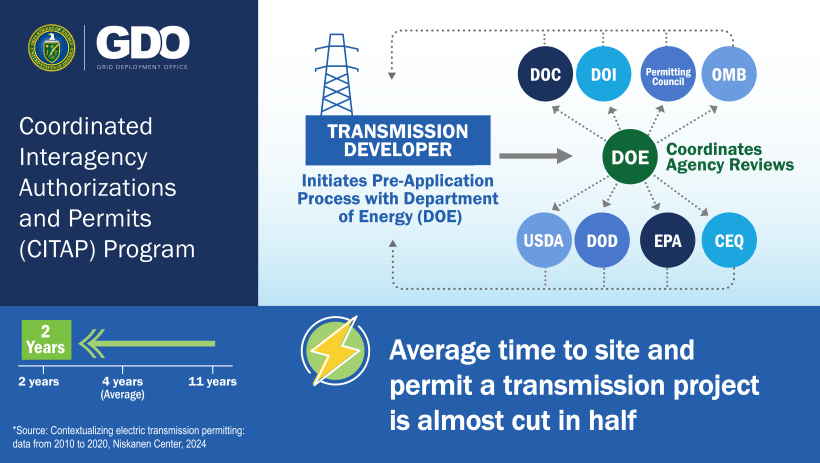
Under the rule announced on Thursday, the Energy Department would take over as the lead agency in charge of federal environmental reviews for certain interstate power lines and would aim to issue necessary permits within two years. Currently, the federal approval process can take four years or more and often involves multiple agencies each conducting their own separate reviews.
“We need to build new transmission projects more quickly, as everybody knows,” Energy Secretary Jennifer Granholm said. The new reforms are “a huge improvement from the status quo, where developers routinely have to navigate several independent permitting processes throughout the federal government.”
The permitting changes would only affect lines that require federal review, like those that cross federally owned land. Such projects made up 26 percent of all transmission line miles added between 2010 and 2020. To qualify, developers would need to create a plan to engage with the public much earlier in the process.
*************
This seems like the old “if we only engaged people sooner, they would like this project” thinking. Here’s the requirement.
DOE requires transmission developers to develop a comprehensive public participation plan before they apply for federal authorizations and permits. This is a new and novel approach to transmission infrastructure development and will ensure that communities and key stakeholders are identified and accounted for at the onset of the permitting process.
Back to the NYT story:
Experts said the change could be significant for power lines in the West, where the federal government owns nearly half the land and permitting can be arduous. It took developers 17 years to win approval for one major line, known as SunZia, that was designed to connect an enormous wind farm in New Mexico to homes and businesses in Arizona and California.
And yet, it is in litigation still as we shall see below. And not mentioned.
“Federal permitting isn’t the only thing holding back transmission, but if they can cut times down by even a year, and if we have fewer projects that take a decade or more, that’s a big win,” said Megan Gibson, the chief counsel at the Niskanen Center, a research organization that recently conducted two studies on federal transmission permitting.
The rule would not affect state environmental reviews, which can sometimes be an even bigger hurdle to transmission developers who are facing complaints and lawsuits over spoiled views and damage to ecosystems.
Nor litigation of course, which can also be a hurdle. But speeding up the progress toward litigation should help.. unless, of course, people speed up the analysis and litigants can find more questions to exploit. I think this is the argument folks have used about NEPA for projects they consider to be less desirable. I think we know this terrain. It all depends on the presence of Groups With Resources Likely to Litigate.
Congress has also given federal regulators the authority to override objections from states for certain power lines deemed to be in the national interest, a potentially contentious move. The Biden administration has yet to wield this power, though it is working to identify potential sites that could qualify.
“We’ve been trying to maximize every nook and cranny of what we can do right now,” said Maria Robinson, head of the Energy Department’s Grid Deployment Office.
Still, experts say, there is only so much the administration can do to expand the grid without help from Congress. To date, lawmakers have struggled to agree on ways to reform the system.
In the House and Senate, Democrats have proposed various bills that would mandate greater grid connectivity between regions or place more permitting authority in the hands of federal regulators. But some utilities and Republicans have criticized those proposals as taking control away from states.
Elsewhere, energy companies have asked Congress to enact permitting reforms that would set stricter time limits on challenges and lawsuits from opponents of new projects. But environmentalists are wary that those changes could also benefit fossil fuel projects such as pipelines.
At a recent conference in New York, David Crane, the under secretary for infrastructure at the Energy Department, said that if he could “wave a magic wand” he would ask Congress for permitting reform to advance renewable energy and transmission projects.
“I would say to people on the left who oppose permitting reform because they think it will lead to more unmitigated fossil-fuel-fired infrastructure, at this point it seems very clear from my vantage point that without permitting reform, what we are hindering is new zero-carbon energy sources,” he said.
My bold. What’s interesting about this is that if an Admin deems that it’s in the national interest, then it can override states. I wonder about Tribes. And according to this article, to environmentalists it’s more important to hold up fossil fuel projects than to increase “zero-carbon” energy. If the billions to build new transmission (from less politically powerful places to more politically powerful places) is coming from the taxpayer, would maintenance of those power lines also fall to the taxpayer? Lots of questions here, especially what regulations can do compared to Congress.
******* Here’s the DOE press release:
DOE is also announcing up to $331 million through President Biden’s Bipartisan Infrastructure Law to support a new transmission line from Idaho to Nevada that will be built with union labor—the latest investment from the $30 billion that the Administration is deploying from the President’s Investing in America agenda to strengthen electric grid infrastructure.
As the Federal government’s largest land manager, the Department of the Interior is working to review, approve and connect clean energy projects on hundreds of miles across the American West,” said U.S. Secretary of the Interior Deb Haaland. “As we continue to surpass our clean energy goals, we are committed to working with our interagency partners to improve permitting efficiency for transmission projects, and ensuring that states, Tribes, local leaders and communities have a seat at the table as we consider proposals.”
The Biden-Harris Administration is tackling those challenges head-on, with today’s new CITAP Program and transmission investment announcement as the latest steps in broad efforts to take on climate change, lower energy costs, and strengthen energy security and grid reliability.
It sounds like maybe the energy costs will be lowered for, say the people in Nevada, but not so much, say Idaho. So Idaho gets the industrial infrastructure and the transmission lines, Nevada gets the energy.
My question is whether there might be a better way to build a clean energy future.. and whether the pros and cons of different alternatives (and costs and benefits) and- especially practicalities (availability of raw materials, supply chains, labor, maintenance) have ever been considered in a transparent way open to public review. Because I haven’t seen it and honestly it’s a bit hard to tell these policies from a solar and wind corporate taxpayer support program.
Anyway, the WaPo story here talks about Tribes and CBD wanting to halt construction on the Sun Zia line (mentioned above as an example of taking too long to permit):
The Tohono O’odham Nation has vowed to pursue all legal avenues for protecting land that it considers sacred. Tribal Chairman Verlon Jose said in a recent statement that he wants to hold the federal government accountable for violating historic preservation laws that are designed specifically to protect such lands.
He called it too important of an issue, saying: “The United States’ renewable energy policy that includes destroying sacred and undeveloped landscapes is fundamentally wrong and must stop.”
The Tohono O’odham — along with the San Carlos Apache Tribe, the Center for Biological Diversity and Archeology Southwest — sued in January, seeking a preliminary injunction to stop the clearing of roads and pads so more work could be done to identify culturally significant sites within a 50-mile (80.5-kilometer) stretch of the valley.
Attorneys for the plaintiffs have alleged in court documents and in arguments made during a March hearing that the federal government was stringing the tribes along, promising to meet requirements of the National Historic Preservation Act after already making a final decision on the route.
The motion filed Wednesday argues that the federal government has legal and distinct obligations under the National Historic Preservation Act and the National Environmental Policy Act and that the Bureau of Land Management’s interpretation of how its obligations apply to the SunZia project should be reviewed by the appeals court.
California-based developer Pattern Energy has argued that stopping work would be catastrophic, with any delay compromising the company’s ability to get electricity to customers as promised in 2026.
Apologies to the Forest Service, the WO Press Office provided this excellent summary of “What is Condition-Based Management: FAQs” in February, and it got lost in my e-pile. My idea was that people of all persuasions often mean different things by CBM and that our discussion would be clearer if we started with “What the Forest Service Thinks it is” since they are the ones using it. There are six pages attached here and I only excerpted the first questions below. Conceivably, we could also look at cases in which the use of CBM wins in court and when it loses, and see if that relates in any way to the topics as addressed below, or to other factors. I was hoping that some law students would look at these cases and share their observations. The Forest Service Office of General Counsel probably has done this work and shared it with the Forest Service, so if anyone would like to share that, it would help our joint learning also.
**********************
What is Condition-Based Management (CBM)?
CBM is a management approach which supports responsiveness and flexibility between planning and implementation in natural resource management. Condition-based management allows for proposed treatments to be aligned—post-decision but prior to implementation—with current conditions on the ground. It does this by focusing on collecting the right data at the right time and selecting the right management activity to move toward desired conditions. Validation surveys completed prior to implementation will determine the current precise site conditions and the best treatment(s).
Here is how it works. At the onset of project planning, known or expected environmental conditions are examined as well as a range of possible management activities. This is done by using mid-scale and site-specific data of current conditions to propose a variety of appropriate treatments to meet the purpose and need and move toward desired conditions. This framework of expected environmental conditions, possible management activities, and likely outcomes are what is disclosed and assessed throughout the NEPA environmental analysis process. Then, once a NEPA decision is made but prior to implementation, current site conditions are confirmed where implementation is to occur. The appropriate management activities are assigned for the site conditions at that time according to the selection criteria and range of management activities in the NEPA analysis and decision. If adjustments are needed to what was proposed, these are made within the constraints of the identified and analyzed range of possible management activities and design features.
NEPA Requirements and CBM
Condition-based management is a method to meet NEPA’s requirements, not to avoid or shortcut them. The increased flexibility CBM offers requires additional work in developing the proposed action, analyzing effects, and engaging the public, and is designed to implement the right treatment in the right place.
CBM projects must meet the site-specificity and public involvement requirements of NEPA. There is no get-outof-NEPA-free card with CBM. CBM is both front-loaded (NEPA) and back-loaded (validation). The courts ultimately decided that NEPA is a procedural statute with twin aims requiring agencies to (1) consider the environmental impacts of their proposed actions and (2) inform the public that they (the agencies) considered environmental concerns in their decision-making process.
It is incumbent upon the Forest Service to provide enough site-specificity in the proposed action, existing conditions, and effects analysis in order to comply with NEPA. A CBM project needs to define and analyze the effects from a range of management activities for defined site conditions in the project area. Using common and easy-to-measure selection criteria (e.g., stand density, level of mistletoe, amount of invasive species) and filters (e.g., vegetation type, critical habitat, nesting habitat) to delineate site-specific conditions for proposed management activities are ways to establish site-specificity. This also gives flexibility to implementers (for example; avoiding important new TES species habitat, putting the right treatment in the right place to move toward desired conditions, and revising stand boundaries if needed to reflect current site conditions).
The following components are recommended in a CBM project:
• Describe the rationale/reasoning for using the CBM approach for the project in the Purpose and Need section. See “When and where should condition-based management be used” section below.
• Use best available site-specific data, for example stand-level data (or data on groups of stands) to describe existing conditions.
• Define a range of treatments/prescriptions needed to move the project area toward desired conditions.
• Based on site-specific data, develop selection criteria (e.g., vegetation/habitat conditions) that will be used to determine which management activities, or range of treatments, should be prescribed, as well as habitat or other filters that will control where treatments will NOT be considered (i.e., condition-management pairings, if-thens).
• Develop design features to be used in alternatives, including those connected to the habitat and other filters described (areas you won’t treat). Include “caps” on number of acres for each management activity/treatment.
• Map anticipated treatment areas by alternative in as much detail as possible.
• Analyze the impacts/effects from the most anticipated treatments for each alternative. Don’t analyze the worst-case scenario, but the “expected,” “anticipated,” or “most likely” scenario or alternative. Clearly and carefully set out all assumptions and methods used in the analysis. Conduct the analysis at the stand or groups-of-stands scale to make the analysis as site-specific as possible. Make the ecological benefits clear.
• Be transparent with the public in identifying the agency’s expectations and anticipated scheduling/timing for implementation. Develop an estimated implementation plan in the NEPA
documents and share with the public.
• Identify in the implementation plan and in the decision how the agency will conduct the required “validation” prior to implementation, such as in a validation checklist. The Responsible Official must ensure that all validation work occurs.
Science informs CBM in the proposal, in the selection criteria used, and in the proposed management activities that will be used with certain site conditions to move them toward desired conditions and make forest ecosystems more resilient to disturbances such as climate change and insect and disease infestations. CBM, as in any other NEPA, uses the best available science to determine what treatments may be needed to do so, to support your effects analysis, and relay uncertainties, but allows the flexibility to determine what is best for site-specific conditions at the time of implementation (rather than a preset prescription based on what is expected).
Why use condition-based management?
Condition-based management allows managers to make decisions with the flexibility to respond to changes in on-the-ground conditions and confirm the right treatment is prescribed and conducted at the right time. This is important because site conditions may change by the time management activities are implemented, they may change rapidly due to disturbance, or a certain order or timing of implementation may be needed. Using a CBM approach works well when there is enough known information to conduct a reasonably detailed analysis and fulfill the twin aims of NEPA. CBM assures that the assigned management activity is responsive to any changes in environmental conditions and is the appropriate treatment to move toward desired conditions. With
the focus on conducting the right treatment(s) for the current condition, more precise implementation choices can be made and there is more certainty in meeting the project purpose and need.
When and where should condition-based management be used?
The CBM management approach is best used when vegetation management activities are being assessed in a landscape where there is a need for flexibility in assigning treatments due to the potential for environmental changes over time. The rationale for this approach and the process for how CBM will be implemented is best described clearly and upfront in the project NEPA document as well as in the decision.
Some situations that indicate when and where CBM may be applicable include:
• When site conditions are dynamic and unpredictable due to reasonably foreseeable environmental stressors, such as insect and disease outbreaks, invasive plant encroachments, and climate change.
• When implementation may take place over a long period of time after the decision, such as in larger, landscape-scale projects.
• Where existing or current data is sufficient to predict effects and outcomes from treatments, but additional site-specific surveys may be needed to confirm the precise current conditions and assign activities at the time of implementation.
These situations are independent of each other and all of them do not need to be present for the potential use of CBM. Condition-based management is not needed when site conditions are predictable and site-specific information and field data are robust and comprehensive for fine-grained analysis. It is recommended that you don’t use CBM if it’s not needed.
We kind of knew that Yellowstone and wolves were more complicated than the “all is well with wolves” idea. Perhaps people went a bit overboard with their “carnivolatry,” but most of us took with several grains of salt..as has been discussed previously at TSW. It’s interesting when folks like the Times discover that there is more than meets the eye to some stories that have been accepted as gospel for some time.
The wolves’ return and predatory dominance was believed to have had a widespread effect known as a trophic cascade, by decreasing grazing and restoring and expanding forests, grasses and other wildlife. It supposedly even changed the course of rivers as streamside vegetation returned.
Yellowstone’s dramatic transformation through the reintroduction of wolves has become a global parable for how to correct out-of-balance ecosystems.
In recent years, however, new research has walked that story back. Yes, stands of aspen and willows are thriving again — in some places. But decades of damage from elk herds’ grazing and trampling so thoroughly changed the landscape that large areas remain scarred and may not recover for a long time, if ever.
Wolf packs, in other words, are not magic bullets for restoring ecosystems.
“I would say it’s exaggerated, greatly exaggerated,” said Thomas Hobbs, a professor of natural resource ecology at Colorado State University and the lead author of a long-term study that adds new fuel to the debate over whether Yellowstone experienced a trophic cascade.
“You could argue a trophic trickle maybe,” said Daniel Stahler, the park’s lead wolf biologist who has studied the phenomenon. “Not a trophic cascade.”
Not only is the park’s recovery far less robust than first thought, but the story as it has been told is more complex, Dr. Hobbs said.
But the legend of the wolves’ influence on the park persists.
A person could ask “if good things happened with more elk killed by wolves, could they have also happened with more elk killed by other predators, including humans?”
Once elk numbers dwindled, willows and aspens returned along rivers and streams and flourished. The beaver, an engineer of ecosystems, reappeared, using the dense new growth of willows for both food and construction materials. Colonies built new dams, creating ponds that enhanced stream habitats for birds, fish, grizzlies and other bears as well as promoting the growth of more willows and spring vegetation.
But wolves were only one piece of a larger picture, argue Dr. Hobbs and other skeptics of a full-blown trophic cascade at Yellowstone. Grizzly bears and humans played a role, too. For eight years after wolves re-entered the park, hunters killed more elk than the wolves did.
“The other members of the predator guild increased, and human harvest outside of the park has been clearly shown to be responsible for the decline in elk numbers the first 10 years after the wolves were introduced,” Dr. Hobbs said.
And wolf-resistant ungulates are growing in numbers..
The changes attributed to the presence of stalking wolves, some research showed, weren’t only the result of fewer elk, but of a change in elk behavior called “the ecology of fear.” Scientists suggested that the big ungulates could no longer safely hang out along river or stream banks and eat everything in sight. They became extremely cautious, hiding in places where they could be vigilant. That allowed a return of vegetation in those places.
Dr. Hobbs and others contend that subsequent research has not borne that theory out.
Another overlooked factor is that around the same time wolves were returning, 129 beavers were reintroduced by the U.S. Forest Service onto streams north of the park. So it wasn’t just wolf predation on elk and the subsequent return of wolves that enabled an increase in beavers, experts say.
Some researchers say the so-called trophic cascade and rebirth of streamside ecosystems would have been far more robust if it weren’t for the park’s growing bison herd. The bison population is at an all-time high — the most recent count last summer found nearly 5,000 animals. Much larger than elk, bison are less likely to be vulnerable to wolves, which numbered 124 this winter.
The park’s bison, some researchers say, are overgrazing and otherwise seriously damaging the ecosystems — allowing the spread of invasive species and trampling and destroying native plants.
Beschta vs. Geremia
“There is a hyperabundant bison population in our first national park,” said Robert Beschta, a professor emeritus of forest ecosystems at Oregon State University who has studied Yellowstone riparian areas for 20 years. He pointed to deteriorating conditions along the Lamar River from bison overgrazing.
“They are hammering it,” Mr. Beschta said. “The Lamar ranks right up there with the worst cattle allotments I’ve seen in the American West. Willows can’t grow. Cottonwoods can’t grow.”
A warmer and drier climate, he said, is making matters worse.
Such opinions, however, are not settled science. Some park experts believe that the presence of thousands of bison enhances park habitats because of something called the Green Wave Hypothesis.
Chris Geremia, a park biologist, is an author of a paper that makes the case that a large numbers of bison can stimulate plant growth by grazing grasses to the length of a suburban lawn. “By creating these grazing lawns bison and other herbivores — grasshoppers, elk — these lawns are sustaining more nutritious food for these animals,” he said.
Dr. Geremia contends that a tiny portion — perhaps one-tenth of one percent — of the park may be devoid of some plants. “The other 99.9 percent of those habitats exists in all different levels of willow, aspen and cottonwood,” he said.
I thought the comments were interesting.. the idea of some is that if bison could just roam freely, everything would be fine. It’s bad western ranchers, and if they were removed, everything would be hunky-dory. Reminds me a bit of previous peoples removed from the landscape with all kinds of good intentions. I didn’t see any comments that a park with 4.5 mill tourists per year (2023) is not really a “natural” place and that Parkies are doing the best they can to find the sweet spot at recreating Indigenous-influenced ecosystems without Indigenous people. Lots of mentions of “balance of nature”, and “what’s the point of the article, no one ever said wolves would solve all the problems caused by humans.”
I do know that I heard much about Yellowstone bison and brucellosis when in carpool in DC with a Lands person in the 1990’s, so the controversy has been going on for awhile.
The heavily grazed landscape is why, critics say, some 4,000 bison, also a record, left Yellowstone for Montana in the winter of 2023-24, when an unusually heavy snow buried forage. Because some bison harbor a disease, called brucellosis, that state officials say could infect cattle, they are not welcome outside the park’s borders. (There are no documented cases of transmission between bison and cattle.)
Montana officials say killing animals that may carry disease as they leave the park is the only way to stem the flow. During a hunt that began in the winter of 2023, Native Americans from tribes around the region took part. All told, hunters killed about 1,085 bison; 88 more were shipped to slaughter and 282 were transferred to tribes. This year, just a few animals have left the park.
The Park Service is expected to release a bison management plan in the coming months. It is considering three options: to allow for 3,500 to 5,000 animals, 3,500 to 6,000, or a more natural population that could reach 7,000.
Richard Keigley, who was a research ecologist for the federal Geological Survey in the 1990s, has become an outspoken critic of the park’s bison management.
“They have created this juggernaut where we’ve got thousands of bison and the public believes this is the way things always were,” he said. “The bison that are there now have destroyed and degraded their primary ranges. People have to realize there’s something wrong in Yellowstone.”
Dr. Keigley said the bison population in the park fluctuated in the early years of the park, with about 229 animals in 1967. It has grown steadily since and peaked last year at 5,900.
Yes, managing wildlife in this world, even in National Parks, can be complex and difficult.
Today, Senators Joe Manchin (D-WV) and John Barrasso (R-WY), Chairman and Ranking Member of the U.S. Senate Energy and Natural Resources Committee, sent a letter to the U.S. Government Accountability Office (GAO) requesting a review of the U.S. Forest Service’s practices concerning forest management, land management plans and firefighting equipment.
America’s wildfire crisis continues to worsen. As your office recently reported, wildfires destroyed more than 12,000 homes, businesses, and other structures each year, on average, between 2017 and 2021. This is more than three times as many than the preceding 5-year period. These wildfires have killed hundreds of people, including 85 fatalities in the 2018 Camp Fire alone, and burned millions of acres. The cost of suppressing wildfires has also risen, from an annual average of $371 million between 1985 and 1990 to $2.85 billion between 2018 and 2022 (an increase of approximately 300% after inflation).
The increasingly devastating outcomes from wildfires in the United States requires a change in how the federal government prepares for, responds to, and recovers from wildfires. Federal agencies have long recognized the need to significantly increase the pace and scale of forest management to reduce the extreme risk posed by wildfires. Nevertheless, efforts to reduce wildfire risk have not been undertaken at the scale necessary to address the crisis. The Forest Service is now recommending that hazardous fuels reduction treatments occur on 50 million acres across the United States over the next 10 years. Although the federal land management agencies have been provided with significant resources to enable this work, both in additional funding and new authorities, increases in proactive forest management have been modest.
In this context, we are writing to request that the Government Accountability Office (GAO) conduct assessments of the following issues:
Forest management. Active forest management can improve forest health and reduce wildfire risk—all while supporting local economies. Congress has provided authorities and funding to the Forest Service in an effort to speed up these projects. However, the agency continues to face questions about the scale and pace of its timber and hazardous fuels management program. We have heard concerns about the extent to which the Forest Service is using the available resources. For example, the Forest Service’s treatment target for Fiscal Year 2025 is lower than the number of acres treated in Fiscal Year 2023. We ask that your office conduct a review of the Forest Service’s use of existing authorities and existing programs that support forest management projects across ownership boundaries. We also request that your office identify improvements to increase the flexibility of federal funds to facilitate cross-boundary forest management work.
It seems to me that there are several questions:
1. Why are targets lower in 25 than 23? Are these timber and fuels reduction targets (both) or only fuels reduction? ( I could look it up, but someone out there probably knows).
2. Where did the funding go that was intended (perhaps “concerns about the extent to which the FS is using resources” is the same question)? Some rumors suggest that increased staffing happened at the WO and Regional level, not at the Districts where work gets done.
3. What has the Forest Service accomplished with the funding? While stashing the funding in Agreements is useful, it is not the end desired result on the ground.
4. It seems like the Westerman bill has ideas to facilitate cross-boundary work. Perhaps GAO will look at those.
FWIW, my previous experience with GAO reports has been uneven, including giving feedback from the agency. It seems sometimes they have an specific axe to grind.
Land Management Plans: Of the 128 Land Management Plans maintained by the Forest Service, approximately 100 are more than 15 years old. These plans provide overall management directives and lay out guidelines for appropriate activities and uses in the forest. It is critical that the Forest Service regularly revises these plans to reflect changing forest conditions, public uses, and Congressional direction. The Forest Service has created new regional teams dedicated to updating land management plans, rather than asking each National Forest System unit to lead the efforts individually. We ask that your office review the Forest Service’s new model for updating land management plans and compare it with strategies employed by other federal land management agencies to identify options for improvement and streamlining.
I’ve heard that there are as many as 150 people employed on those teams. Also I’m sure there are documents describing exactly what the new organization is, although I don’t think that they are public. I think the only other agency that does similar kind of planning is the the BLM, so it shouldn’t take GAO long to look at this. And I don’t agree, of course that getting them done is “critical.” If Congressional direction changes, conceivably the FS would follow it without requiring all units to do plan revisions (!). And then there’s the planned national OG amendment..
Firefighting equipment. Technology such as Global Positioning Systems (GPS) and communications devices are critical safety equipment for firefighters working to suppress wildfires or conduct prescribed fires. However, these systems have not been universally implemented or adequately maintained. A recent report from the President’s Council of Advisors on Science and Technology identified improved communications and situational awareness tools as the number one technological priority for firefighters. Congress provided federal agencies with funding to purchase such equipment, including $15 million through the John D. Dingell, Jr. Conservation, Management, and Recreation Act (P.L. 116-9) and $40 million through IIJA. However, it is unclear if the Forest Service has purchased any equipment with these funds. We ask that your office review what steps the agency has taken to assess and acquire this equipment and any reasons for delay.
I think it’s a bit odd for this request to refer to the PCAST report– here are the leads on that…
Co-Leads
John O. Dabiri
Centennial Professor of Aeronautics and Mechanical Engineering
California Institute of Technology
Kathryn D. Sullivan
Former NASA Astronaut
Former NOAA Administrator
Members
Ash Carter (1954-2022) Director, Belfer Center for Science and International Affairs and Belfer Professor of Technology and Global Affairs
Harvard University
Inez Fung
Professor of Atmospheric Science
University of California, Berkeley
Steve Pacala
Frederick D. Petrie Professor in the Department of Ecology and Evolutionary Biology
Princeton University
William Press
Leslie Surginer Professor of Computer Science and Integrative Biology
The University of Texas at Austin
**************
I’d have more confidence in “what technology is needed” from people doing the work. Not that the Congress’s Wildfire Commission had many firefighters on it, but here is what they came up with: Recommendation 118.
While not a comprehensive review, the Commission notes a particular need for the following technologies be prioritized for greater development and adoption:
Chapter 6: Integrating Modern Science and Technology 213
• Expanded adoption of interoperable communication systems and extended field connectivity to all firefighting resources.lxii
• Incentivized and improved fire detection technologies including along electric utility corridors.
• The development of dynamic risk maps for the wildland environment that are updated regularly to better reflect changes in the natural environment, such as post-flood or fire alterations. While this process may take time, the development of such dynamic maps is important to better reflect rapidly changing environmental conditions.
• Improved resource tracking on wildfire incidents.
• Continued investments in innovative wood products and biomass utilization to help defray mitigation costs in the wildland environment.
• Rapid remote detection of vegetation change to inform fire risk and fire behavior models.
The Commission emphasizes that modernizing the wildfire mitigation and management space requires exploring and integrating new technology as well as more fully supporting and implementing existing technologies.
***********************
It’s interesting how DC-centric this all seems to be. We will have DC people (GAO) take a look at what the FS is doing in forest management with the funding we gave them. To me that makes some sense, although I would ask different questions. They tell us that more plan revisions are …”critical”. Not everyone thinks that. And finally looking to PCAST instead of the Wildfire Commission for direction on what to fund. I’d just ask the Forest Service these questions directly, and maybe ask a panel of us regulars from across the country to review -and compare with the BLM plans for example on the planning side. Not as written about, but as experienced from both the public and the practitioner side.
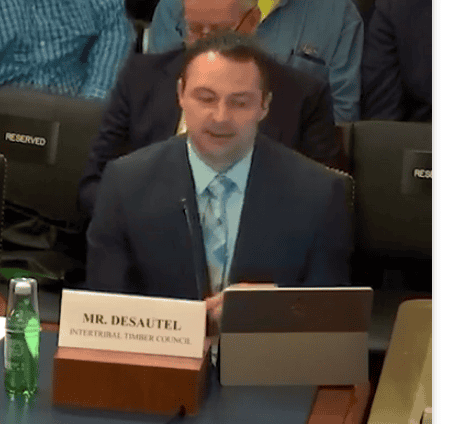
The E&E News article on the hearing did not mention Mr. Desautel’s testimony, and I didn’t see it covered elsewhere other than Tribal news sources, so I thought I’d focus a post on it.
Thanks to Nick Smith for the link to this video of Cody Desautel on Indianz.com. Below is an excerpt from the Indianz.com story.
Desautel, a Colville citizen, spoke of the need to include tribal governments in federal forest policy. He specifically pointed to the risks that tribes face from wildfires on federal lands, many of which include treaty territories. Federal lands also lie adjacent to a number of reservations.
“When these lands don’t receive adequate management, or are severely damaged by wildfires tribes feel the impact,” Desautel stated in his written testimony.
Desautel appeared at a hearing before the House Subcommittee on Federal Lands, which is part of the House Committee on Natural Resources. The hearing was called to discuss a Republican-led draft forest management bill that has not yet been introduced in the 118th Congress.
Let’s take a look at which of the ideas in the Westerman Bill that the ITC supports. Here’s a link to his written testimony.
The legislation primarily uses a combination of priority firesheds identified in the “Wildfire Crisis Strategy” and existing national Fireshed Registry ratings to prioritize fuels reduction projects. The ITC recommends adding a provision that allows states and Indian tribes to identify and request additional areas for assessments and treatment. Wildfire is a complex phenomenon that can be unpredictable. Many of the areas most devastated by wildfire in recent years do not appear on the Registry at all. Likewise, areas that have burned in recent years are treated at a lower risk of future wildfire. While that may be true in the very short term, large areas with standing dead snags may pose a much greater risk of catastrophic fires as time goes on. We recommend more research about how to calculate wildfire risk from these massive dead zones on federal lands
********
Treat Tribes the Same as Other Governments for Implementation (NEPA) Authorities
The ITC appreciates that the bill authorizes tribes to request participation in producing the fireshed assessments. Tribes are best situated to define risks, strategies for reducing the threat of those risks, and determining the benchmark goals for their communities. For the sake of parity, we request that Tribal Forest Protection Act projects on federal lands be provided the same implementation authorities, such as emergency NEPA procedures and categorical exclusions. This would be helpful in accelerating TFPA treatments across the country.
A prime example of this is the Tule River Tribe’s TFPA project in the Sequoia National Forest in California. The NEPA process for the project, intended to protect giant sequoias from stand-replacement fire, took roughly a decade to get through. By the time of implementation, wildfire was already affecting the sequoia stands. Congress ultimately stepped in to create emergency authorities for fuels treatment.
ITC would recommend that the Bureau of Indian Affairs be included as a member of the Community Wildfire Risk Reduction Program. The BIA is included as a representative in the Fireshed Center and Public-Private Wildfire Technology Deployment and Testbed Partnership, and should serve in the same capacity to protect tribal interests in this program.
***********
The Colville tribe is working through a similar situation where a TFPA project that shares 10 miles of boundary with the reservation was approved in 2014, later reduced because of the 2015 Northstar fire, and had the NEPA decision litigated in 2023. Now –10 years later—we are working on a new version of the project with no treatment accomplished on the ground to date. While tribes understand the importance of environmental review, we also understand that we must live with those decisions and justify our actions to our tribal membership. Decisions that impact natural and cultural resources are not things we take lightly.
********************
The ITC appreciates the inclusion of traditional ecological knowledge in the definition of “Best Available Science” used in the fireshed assessments. This can be a critical tool to better understand the historic forest characteristics and fire behavior. It will be important to respect the tribal sovereignty of our 574 federally recognized tribes, and ensure we have a process for collection and protection of this data that meets the needs of each tribal government. The ITC also appreciates the inclusion of cultural burning as a designated fireshed management project. For many tribes this will be a critical tool to accomplish their risk reduction goals.
The ITC supports the bill’s provisions that address full tribal inclusion in Good Neighbor Authority, and adding the National Park Service and U.S. Fish & Wildlife Service to that authority. We also support extending the length of stewardship contracting authority. To ensure we have the infrastructure needed to accomplish these fireshed management goals we will need a healthy forest products industry. To achieve this, we must have long term commitments to forest products supply chains. The Wildfire Mitigation and Management Commission also recommended investments in wood processing facilities and the wood utilization sector more generally.
***************
Litigation Reform
The bill’s provision on litigation reform mirrors existing direction from Congress in the Healthy Forests Restoration Act. Since federal forests are often managed by the whim of federal courts, we believe it is reasonable for Congress to direct courts to weigh the long-term effects of fuels reduction versus wildfire impacts to untreated areas. With approximately half of the reservation burning over between 2015 and 2021 we have firsthand experience with fire effects on untreated areas. Although we have an active forest and fuels management program, we are not funded to work at the pace and scale needed for our forest types. The consequence is high severity wildfire in many of untreated areas. It would be irresponsible to assume “no action” means “no impacts” as we continue to see the growing impacts past management practices and climate change.
*************
Better Accounting of Accomplishments
We also support better reporting of fuels reduction projects by type and effectiveness. A true accounting of footprint acres with a quantified risk reduction will help track our success, and inform future investments and projects. We would recommend the work done by the Department of the Interior to consider the “avoided costs” of various fuels treatments.
The ITC also supports the creation of an interagency group focused on technology development and deployment. The Wildfire Mitigation and Management Commission had 16 recommendations dedicated to the integrating modern science and technology. By collaboratively combining the resources of the federal agencies, academia, and private industry we can utilize existing tools, and develop new tools that improve our effectiveness in achieving these wildfire risk reduction goal.
On the whole, the ITC supports the intent of this legislation to accelerate the pace and scale of high priority fuels work on federal lands. The ITC requests that the Committee review additional recommendations to Congress from the Wildland Fire Mitigation and Management Commission report, particularly those that involve tribes and tribal forest and fire management
************
How much sovereignty do Tribes have over different National Forests (I assume it varies by Forest)? How would the Tribal rights be balanced, say if a Tribe were concerned that a project to protect their hunting and fishing or other rights were held up by litigation in court? This seems like an interesting legal area.. maybe someone knows more about this.
I earlier posted a piece on the Forest Service’s Keystone Agreements with a variety of NGOs. These agreements are meant to accomplish a wide variety of tasks that would normally be done either by the Forest Service itself or through normal contracting procedures. I said that we had submitted several questions to the Forest Service and we were awaiting their response. Last week, we received that response from the Forest Service’s Office of Communications.
The following shows our numbered questions along with their responses in bold:
(1) We have obtained copies of the Master Agreements with the various NGO’s through FOIA’s. We are interested in the details contained in the associated SPA’s, particularly the financial information. Shouldn’t this information be available to the public? We believe it is important to know how the Forest Service is spending federal dollars through these agreements. Do we need to file FOIA’s to obtain this information or could it just be available online? If not, why not? We realize there would be some proprietary information that would need to be redacted.
Each Forest and Region that has executed agreements that are tied to the Master Keystone Agreements has specific plans to implement those projects. Some are at various stages of implementation and readiness and a financial plan does not depict the context necessary to appreciate the implementation of the agreement goals fully. Due to the constantly changing nature in the status of work, we don’t post this information online, as it is not static. We suggest working with individual units to understand their Forest’s or landscape’s holistic partnership and collaborative goals so that entire project areas and landscape goals from A-Z can be seen rather than a snapshot of one financial plan. Those program managers will also be able to speak to financial planning and other relevant plans and appendices or modifications the agreements have associated with them so that these iterative agreements can be fully understood.
(2) How are accomplishments being tracked through these agreements? Who is providing oversight, Grants and Agreements? Partnerships Office?
Accomplishments are being tracked at a local, regional, and national level through our agency’s authoritative data sources. We are monitoring financial burn rates and programmatic outputs, among other things. Forest staff, program managers, and grants and agreements staff collectively provide oversight to ensure the successful implementation of the agreement with our partners.
(3) What is the process of awarding the NGO’s funding? Do they receive the dollars and then projects are developed? What are the overhead rates of the various NGO’s?
The need to treat hazardous fuels across the United States has been identified in great detail and is addressed in the Wildfire Crisis Strategy outlined by the FS Wildfire Crisis Strategy published in 2022. Regions and Forests with identified needs have received funds to implement project work through contracts and agreements. Some of these agreements are with partners that have a Keystone Agreement, who may have established relationships with the region or forest to address these needs. While the “umbrella” or Master “Keystone” Agreements with partners are held at the Washington Office, the actual project work and funds that are added to the agreements are often done at the regional level, Wildfire Crisis Strategy landscape level, or at the Forest level. The projects are developed at the local level and then appropriate funds for the work, once identified, are awarded to the Supplemental Project Agreements in conjunction with inputs from the partner. Each NGO has its own Negotiated Indirect Cost Rate Agreement (NICRA). Each NICRA is negotiated with the cognizant agency for the partner. The federal agency that provides the most in direct funding is normally the organization’s cognizant, unless specifically assigned by the Office of Management and Budget.
(4) Are the Keystone Agreements being used to avoid Federal Acquisition Regulations and federal hiring difficulties?
No, the Keystone Agreements are not being used to avoid Federal Acquisition Regulations nor federal hiring difficulties. Keystone agreements were developed to implement projects at a pace and scale aligned with the objectives of the Forest Service. The Forest Service is taking this opportunity to achieve our mission in new ways, building on long-standing partnerships and creating large, national-level agreements—or Keystone Agreements—for BIL and IRA implementation. These agreements will allow us to execute priority projects quickly and efficiently while we grow Forest Service institutional capacity. Importantly, these Keystone Agreements facilitate new local agreements or complement existing agreements at the region and unit levels, creating a suite of partnership arrangements that collectively give our national forests and grasslands a range of tools for program implementation. These agreements can increase capacity, to help accomplish crucial work on the ground in an expedited manner.
(5) We are hearing that Forests are having budget difficulties this fiscal year and that it will impact their ability to hire employees. In hindsight, was it wise to put so much funding into the Keystone Agreements rather than into NFS? Could a lot of this funding have been put into IDIQ contracts instead?
The agency has invested a tremendous amount of BIL and IRA funding in the WCS landscapes, high risk-firesheds, and to a much smaller extent, funding for state agencies, tribes and Keystone Agreements. Some of the BIL and IRA funding did go into IDIQ contracts. Due to the significant workload and goals of the Wildfire Crisis Strategy, an array of tools were utilized to help accomplish the work. In addition, a large number of new employees were hired within the agency to address the workload.
(6) Are Keystone Agreement accomplishments being claimed when the funding is awarded rather than when the work is actually accomplished?
Accomplishments are recorded when the work is completed. The exception is when timber is sold through a contract or stewardship agreement. The “timber volume sold” accomplishment is recorded when an agreement or contract is fully executed. Funding obligations and are also tracked for budget expenditure purposes.
Understanding that you may want additional documents that are not publicly available, we recommend you request the data through the Freedom of Information Act. This link provides contact information for the WO processing center: FOIA Contact Service Centers | US Forest Service (usda.gov). The more detailed the request the better.
**********************************
I certainly appreciate the Office of Communication responding to our questions and I feel that I have somewhat of a better understanding of these Keystone Agreements. However, I think those of us who are interested in Forest Service operations should still have some concerns regarding their implementation.
It’s just my opinion but these huge funding bills have had a really mixed outcome regarding the Forest Service. I remember the National Fire Plan in 2000, which promised a significant increase in funding into the future, but much of that increase dried up after a couple of years. The 2009 Recovery Act provided a lot of money and we were scrambling on how to get it spent. I know some good things were funded, but personally, I saw some projects that had the appearance of just spending money to get it spent.
Is the Forest Service doing the right thing with these Keystone Agreements? I don’t know but if they are resulting in a significant bump in accomplishments, the Forest Service is not doing a great job in telling that story. You would think with all of the money being spent, the Forest Service would have an excellent public relations plan regarding these agreements. It should not be difficult to find out what is happening with them. Do you think the Forest Service has done well at explaining their value? Are they a good use of taxpayer dollars?
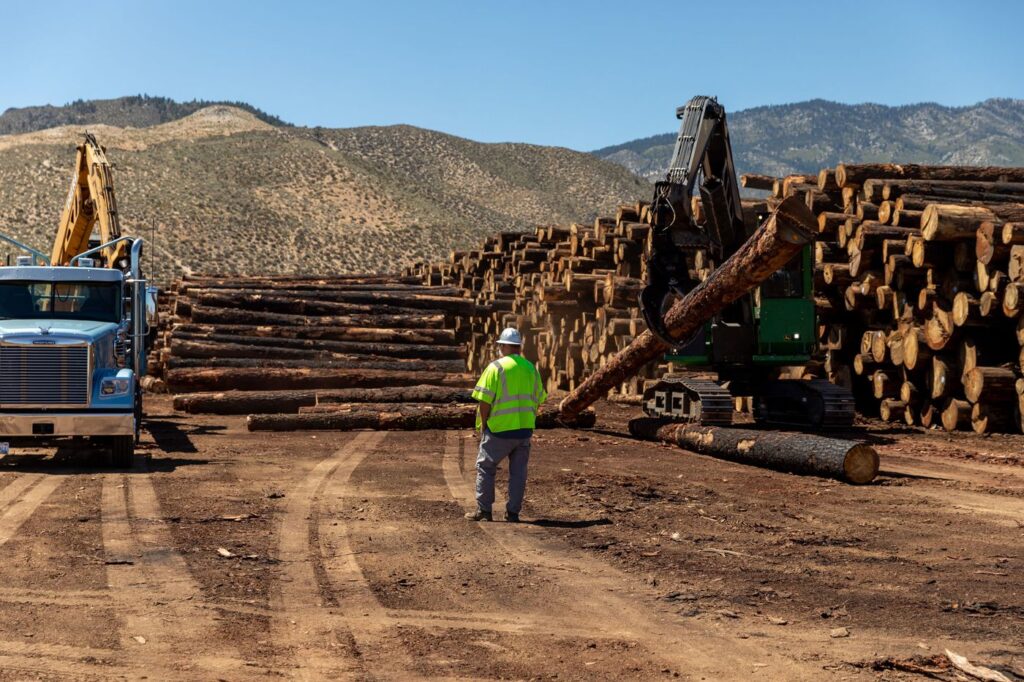
New Tahoe Forest Products Sawmill (courtesy of Bloomberg)
There were many interesting things to explore with the hearing on the Westerman Bill yesterday. As we saw in previous posts, it’s a compendium of many different ideas we can explore in greater depth. What I thought was one theme in Chris French’s testimony was what we might call another Wood Wide Web (broader than the mycological one discussed here a few weeks ago), this one of people, workers and organizations making useful products of wood.
Certainly mycorrhizal fungi help trees. But also people help trees, at least around here, by thinning them and protecting them from fires, planting them and so on. And trees provide us with useful products, often more environmentally friendly than those produced from minerals of various kinds. So, in fact, we as humans have some mutualism going on here with trees. And within that mutualism, we have a complex interrelationship of businesses and workers (from sawmills to CLT to paneling to furniture to horse bedding to sawdust to biochar to bioenergy) that depend on each other. And people who depend on the products they produce, plus employment, plus taxes. So indeed people have their own Wood Wide Web, and while Chris didn’t talk about it in those words, he made the point that this Web is important to forests surviving and thriving into the future, come climate change, wildfires and a variety of other stressors. Or at least that’s how I heard it. We are, indeed, all in this together.
********************************************
Housing is a crisis in many places in the US. And the US is allowing large numbers of migrants in (at least 2.5 million according to NPR) (not judging, just observing). It seems logical that we would need even more housing. Housing tends to be built using wood for various reasons, including cost. We have lots of extra wood from fuel treatment and restoration projects, but it tends to be small. Will new materials like CLT help us build our way out of the housing crisis? Certainly if we look at the Wood Utilization grants of USDA, there is much effort (and funding) going toward Mass Timber, CLT and other efforts. Maybe the future is small, local mills, with local employees scattered through the landscape. Which is kind of what we had, previously, except in the past they focused on larger dimension lumber.
I’m not a fan of top-down industrial policy, but if the wildfire folks can have a Cohesive Strategy, I don’t see why, given the massive amounts of biomass to be otherwise burned, we can’t have a Coherent (and what the heck, let’s throw in Cohesive also) Strategy.
Current Dimensions Used (from AFRC)
I was curious about the size of material being used by current timber industry (including CLT mills). I know there are university and Forest Service experts out there, so hopefully they will add information here or you all can add good contacts.
AFRC generously provided me with their perspective on dimensions:
Log utilization is an ongoing point of contention between the federal agencies and AFRC. The Forest Service in Region 6 generally classifies minimum specifications for sawtimber as an 8-foot log with a small-end diameter of 5-6 inches for most conifer species. The only exception is ponderosa pine where they use a 16-foot log. AFRC has been advocating that the Forest Service use a 16-foot log for all conifer species for several years since most all of our members assert that 8-foot logs with 5-6 inch diameters do not get processed as saw material, but rather end up as pulp or chip material. Most of our members whose mills are designed to utilize small logs are capable of sawing or peeling down to 5-6 inches, but some minor variations exist. However, when delivered as an 8-foot piece, the economics of doing so becomes marginal—hence our advocacy to change that length.
The CLT facilities that I’m familiar with (Freres in Lyons and DR Johnson in Riddle) do not actually process raw logs—instead they secure veneer that has previously been peeled or boards that have previously been cut at other mills and then manufacture them into larger products by gluing them together. Generally speaking though, the products that are delivered to CLT facilities can be cut/peeled from small, medium, or large logs.
From loggers to end users – all of whom are currently involved in a complex exchange of material and value. Fiddling with a part may cause a series of consequences throughout the web. And 16 foot logs with 5-6 inch diameters are pretty small. With, no doubt, transportation costs being a big thing. Again, the web. Again, the need for a Double C (cohesive and coherent) strategy.
Academic Horsepower and Successful Industry-Chicken or Egg?
If your state has a prominent forest industry, generally (but not always) universities hire experts to help them, and conceivably the rest of us who use wood or want to get rid of biomass. But if your state doesn’t, then they probably don’t have experts. Which could be a problem if you want to support new industries, in that there are no/few experts to help entrepreneurs.
As I was writing the above on transportation costs, I received an announcement of a webinar by Drs. McConnell and Tanger who seem to be forest economics/wood utilization/operations experts.
Wood-using sawmills prioritize availability of raw materials, their accessibility, and associated transportation costs as the main drivers of new mill constructions and financial viability of existing mill operations. One of the major hurdles faced by the forest sector is hauling costs. Hauling costs have commonly been cited as comprising 35 to 45% of the delivered cost of round wood. Join us to learn how road network repairs could benefit both the forest sector and the broader Mississippi economy.
California’s Wildfire and Forest Resilience Task Force Market Development Program
I don’t know how many economics and utilization professors California has (I know there’s some in Extension) but they have a market development program that’s interesting. They have five pilot programs:
to establish reliable access to forest biomass through a variety of feedstock aggregation mechanisms and organizational innovations. The pilots will develop plans to improve feedstock supply chain logistics within each target region through the deployment of a special district with the authority and resources to aggregate biomass and facilitate long-term feedstock contracts. Each pilot will assess market conditions, evaluate infrastructure needs, and work to enhance economic opportunities for biomass businesses in their project regions. The pilots are distributed across 17 counties in the Central Sierra, Lake Tahoe Basin, Northeast California, North Coast and Marin County.
Their rationale is:
Diverting forest residues for productive use can help increase the pace and scale of forest restoration efforts in California, reducing vulnerability to wildfire, supporting rural economic development, and promoting carbon storage. The Wildfire and Forest Resilience Action Plan identifies the development of, and access to, markets for these residues as a key barrier to conducting necessary treatment activities across priority landscapes in the state. The development of such a market for residues has been hampered by the lack of any centralized broker capable of entering into long-term feedstock supply contracts.
Washoe Sawmill Opens
I posted about this last year, The Tahoe Fund, Tahoe Forest Products LLC, and the Washoe Development Corporation worked together to build a new mill. Here’s a link to a Bloomberg story. Region 5 has a good story about it opening, with some interviews and a historical perspective. Shout out to writer Andrew Avitt!
“The truth is, the forest, it needs our help,” said Serrell Smokey, Tribal chairman for the Washoe Tribe of Nevada & California, at the Tahoe Forest Products sawmill opening Dec. 18, 2023, “Our people have intervened in these areas since the beginning of time, because otherwise, if we don’t take care of it, it will take care of itself.”
********
There is a mutually beneficial relationship here – land management agencies need to treat landscapes and the timber industry needs timber. There used to be an old saying of “trees paying their way out of the woods.” That meant the value of the timber would help offset the cost of treating an area. While that’s not the reality on the eastern side of the Sierras, having a mill infrastructure in proximity drastically improves the economics of the type of work that’s needed to restore landscapes in the West.
When timber business makes assessments about when and where to take on a contract, they look at a number of factors — fuel and labor costs, and market prices for timber. But there is one factor that tends to be the most prohibitive — distance.
The further a log has to travel to arrive at the nearest mill increases fuel and labor costs and decreases a business’s profit. Depending on all the variables, the breakeven distance is about 50-80 miles from forest to mill.
Before the opening of Tahoe Forest Products mill in Carson City, the closest mill was in Quincy, California. That’s more than 100 miles from many of the areas that need work on the Humboldt-Toiyabe National Forest.
“Since the mill has opened the conversation has definitely changed,” said Monti, “Now contractors are calling and saying, ‘hey, I heard this new mill went in. I’m really interested in doing work on this side of the mountain.’… We have not had that option for the last several decades.”
Note the transportation costs, and the shimmering of the beginning of a new working-wood-wide-web. I always wonder why California seems to be different from Oregon in its appreciation of the Web- maybe the Timber Wars are still resonating.